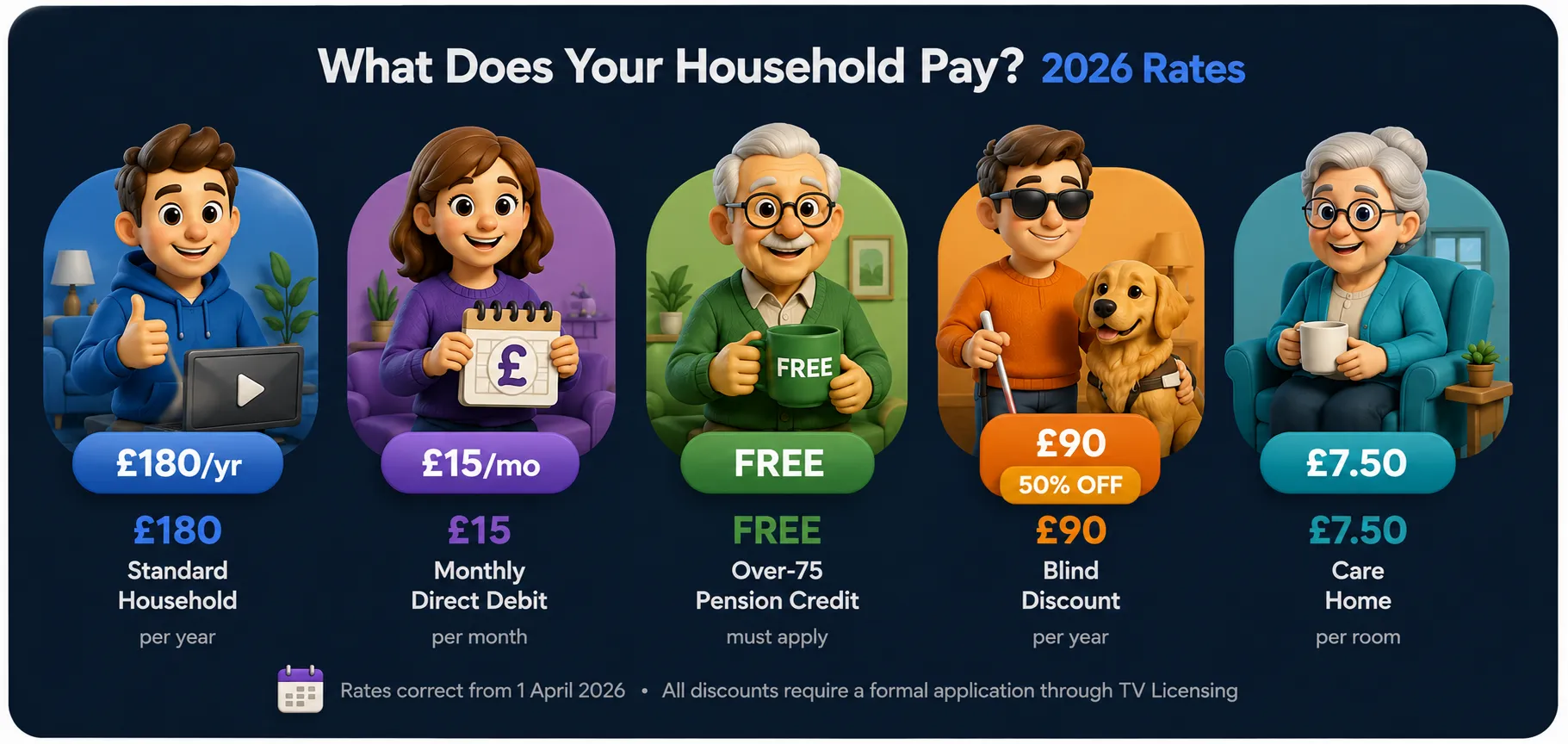
A standard colour TV licence costs £180 per year from 1 April 2026. That works out at £15 per month or 49p per day. Pensioners aged 75 or over who receive Pension Credit pay nothing. Everyone else, including those aged 80 or over without Pension Credit, pays the full £180.
How Much Does TV Licence Cost in 2026?
The annual fee rose to £180 per year on 1 April 2026. This is a £5.50 increase on the 2025 rate of £174.50, driven by a 3.15% CPI inflation uplift announced by the Secretary of State in February 2026. The licence cost is set by the government, not the BBC itself, and the current system ties annual rises to inflation until the BBC Royal Charter expires in December 2027.
One licence covers every device in your household. You do not need separate licences for each television, laptop, tablet or smartphone at the same address.
|
Colour TV licence |
£180.00 per year |
|
Black and white TV licence |
£60.50 per year |
|
Blind/severely sight-impaired (50% discount) |
£90.00 per year |
|
Over-75 receiving Pension Credit |
Free |
|
Care home concessionary (per room) |
£7.50 per year |
Cost Per Month, Week and Day
Many households prefer to think of the cost in smaller units rather than as a single annual figure. Here is how the £180 annual fee breaks down:
|
Per year |
£180.00 |
|
Per month |
£15.00 |
|
Per week |
£3.46 |
|
Per day |
49p |
If you pay by monthly Direct Debit, TV Licensing takes exactly £15. There is no surcharge on monthly payments. If you choose quarterly Direct Debit, the Tv licence cost rises slightly to £185 per year due to a £1.25 surcharge per quarter.
Monthly or annual Direct Debit carries no surcharge, making it the cheapest option. Quarterly Direct Debit costs an extra £5 per year. PayPoint cash payments and cheques are also surcharge-free if you pay the full annual amount in one go.
TV Licence Cost for Pensioners
This is where a lot of people get confused. The short answer is: your age alone does not determine what you pay. What matters is whether you receive Pension Credit.
Over-75 + Pension Credit
Free
You pay nothing. Both conditions must be met: aged 75 or over, and you or your partner receives Pension Credit (Guarantee Credit, Savings Credit or both). You must apply — it is not automatic.
Over-75, No Pension Credit
£180
You pay the full standard rate. The State Pension alone does not qualify you. If you are on a low income, check whether you might be eligible for Pension Credit — it is significantly underclaimed.
Over-80s: What Do They Pay?
Being aged 80 or over does not give you any automatic reduction or exemption. The TV license rules are identical to those for over-75s: you need to be receiving Pension Credit to get a free licence. If you are 85 or 90 and not on Pension Credit, the licence cost is the same standard £180 per year.
Around 800,000 UK households who qualify for Pension Credit are not receiving it. If you or someone you know is over 75 on a low income, checking Pension Credit eligibility could unlock both the benefit itself and a free TV licence worth £180 per year. Use the government’s Pension Credit calculator at gov.uk to check.
BBC Licence Cost for Pensioners: How It Changed
Before August 2020, every household with someone aged 75 or over received a free licence automatically, regardless of income. That changed on 1 June 2020 when the BBC took over responsibility for the concession from the government and decided it could only afford to fund it for those on Pension Credit. Since then, the free licence has been means-tested.
Fee History: 2017 to 2026
The fee has not always risen each year. There were two notable freeze periods — one from 2010 to 2017, and one from 2022 to 2024 — before CPI-linked rises resumed.
|
Year |
Annual Cost |
Change |
Notes |
|
2017 |
£147.00 |
+£3.50 |
CPI-linked rises begin |
|
2018 |
£150.50 |
+£3.50 |
CPI increase |
|
2019 |
£154.50 |
+£3.50 |
CPI increase |
|
2020 |
£157.50 |
+£3.50 |
CPI increase; free over-75s ended Aug 2020 |
|
2021 |
£159.00 |
+£1.50 |
Final rise under 2017 settlement |
|
2022 |
£159.00 |
Frozen |
2-year freeze announced |
|
2023 |
£159.00 |
Frozen |
Second year of freeze |
|
2024 |
£169.50 |
+£10.50 |
CPI restoration after freeze |
|
2025 |
£174.50 |
+£5.00 |
CPI increase (3.15% rounded) |
|
2026 |
£180.00 |
+£5.50 |
Current rate from 1 April 2026 |
Why Did the Cost Jump So Much in 2024?
The £10.50 rise in 2024 looks large because it was. The 2022 to 2024 freeze meant two years of inflation went unrecovered. When the freeze ended and CPI-linked rises resumed in April 2024, the fee had to catch up, resulting in the biggest single-year increase in decades. The 2025 and 2026 rises of £5 and £5.50 are more typical of what a standard CPI-linked adjustment looks like.
What Does the Fee Pay For?
The £180 annual fee funds a wide range of BBC services. These include BBC One, BBC Two, BBC Three, BBC Four, CBBC and CBeebies on television; BBC Radio 1 through to BBC Radio 6 Music and local stations; BBC iPlayer, BBC Sounds and the BBC News website. In Wales, a portion also funds S4C, the Welsh-language broadcaster, which received approximately £100 million in 2026/27.
The fee raised around £3.8 billion in 2025/26. Around 12.5% of households that should hold a licence are estimated not to. The BBC describes evasion as one of the main pressures on its finances, alongside rising production costs and competition from streaming services.
Watching live TV or using BBC iPlayer without a valid licence is a criminal offence carrying a maximum fine of £1,000 in England, Wales and Northern Ireland. The evasion rate rose to 12.52% in 2024/25 — the highest in recent years — meaning more households are being investigated.
How to Pay
TV Licensing offers six payment methods. The fee is the same regardless of how you pay, with one exception: quarterly Direct Debit carries a £5 annual surcharge.
Annual Direct Debit
Full £180 taken once per year automatically. No surcharge.
Monthly Direct Debit
£15 per month. No surcharge. Most popular option.
Quarterly Direct Debit
Four payments per year. £1.25 surcharge each quarter — £185 total annually.
Debit or Credit Card
Pay £180 in full online or by phone. No surcharge.
PayPoint
Pay with cash or card at a PayPoint outlet using your TV Licensing payment card.
Simple Payment Plan
For households in financial difficulty. Smaller flexible instalments at no extra charge.
Will the Cost Go Up Again?
The current BBC Royal Charter runs until 31 December 2027. Under the 2022 Licence Fee Settlement, the annual fee is set to rise again in April 2027 by CPI inflation. That will be the last adjustment under the current Charter period. The exact amount depends on the inflation figure used at the time of the government’s announcement, expected in early 2027.
From 2028, the funding model could change entirely. A government consultation closed in March 2026 and a White Paper is expected later in 2026 or early 2027. The government has said it is keeping an open mind about future BBC funding and has not committed to continuing the licence fee beyond 2027. Until any change is formally announced and legislated, the current system remains in place.